Wednesday, January 25, 2012

Clouds.

I've had one, repeat, one (1!) night with clear skies since I wrote the last post. I did make the best I could of that and hopped in the car armed with binoculars and some idea of what I wanted to look at. I stayed with Orion because, well, because I need to start somewhere.

So I went over what I already knew about it; Betelgeuse, the Orion nebula, and then stayed with Rigel for a minute or two. Realized that I don't really recognize as many constellations as I thought I should and had a look at what little I knew I could name: The big dipper and follow the backside of the "cart" (the Swedish name for it, Karlavagnen, means a cart not a ladle) up until I find Polaris. Okay, check.

Then took the binoculars down and looked up and around. Found a very bright star seemingly alone, straight above me. What is it? Well, here's where my SkyView app came in handy. I pointed it straight up, and it told me the name of the star. What was it? I don't remember. But then tonight, as I was writing this post I used the simple fact that I'm still in the same place, it's the same time of year, and even though it's a cloudy night SkyView doesn't care what the outside looked like. So sitting in my couch I pointed my phone up and, sure enough, there it was. Capella.

Capella is a pretty cool star in that it's not a star at all. It's actually four stars, but the two that you can see (although "they" sure looked like "a" star through binoculars) are two giant stars circling each other very closely. How closely? About the distance of the earth to the sun! Two stars, the smallest of which has a radius of 9 times the sun, circling each other closer than our sun is to us. To put that into perspective, if that can be done, it's... Well, if you're on the surface of the bigger of the two stars and look up at its sister in the sky, it would take up (if my calculations are correct, see picture) 7.5 degrees of the sky, or fifteen times the apparent diameter that the sun has in our sky.


I haven't done trigonometry for quite awhile, but I had help from a Certified Math Teacher who I'm married to who made sure I wasn't getting too far off track in doing the calculations. Once I was done, I tried to find out if there was a way to look up the answer online and found out that someone - of course - has written a Wikipedia article on angular diameter which is used for specifically this. Still, I feel a little bit smarter for figuring out the equation on my (mostly) own instead of googling it.

Now, please - some clear skies!

Sunday, January 8, 2012

Amateur astronomy starts now

New hobby: Amateur astronomy. New function of the blog: Astro log. That's all I have to say about the transition from poker to astronomy.

--

Step 1 was to buy a pair of binoculars, and I went with a pair of Celestron 15x70 (that is magnification x aperture, or width of the main lens) which are decently heavy but pick up a lot of detail, pictured below. I'll get to buying a telescope eventually, but have now decided that there's plenty to look at and learn before I take that step.

I've had a couple of peeks at the night sky already, but as I'm starting the log tonight, I'll add only tonight's views to it:

Venus
Low in the sky, very visible, looked crescent, but hard to tell.

Jupiter
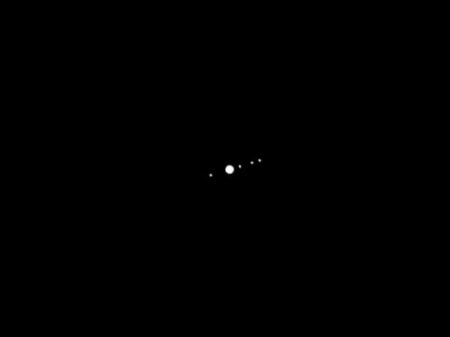
I can't help myself - have to look at Jupiter now that it's so close, despite having done it every time I'm outside and it's clear in the last two weeks. Got a decently still view of it by leaning against the wall to remove jittering of shaking hands. Seeing Jupiter's moons is so. Very. Cool. Looked basically like this (but two on the left and one on the right instead of all four tonight):

Jupiter in binoculars
(Picture courtesy of 10 Minute Astronomy)

Moon
It's really very blinding without a filter and I find that it's actually nicer to look at it through a light cover of clouds. But it was a full moon, and I had to give it a look. Note to self: Learn some of the names of the major landmarks. Especially that crater in the "southwest" corner that, as my mom put it, makes it look like it's an orange. Investigation still ongoing.

Betelgeuse
My first thought was "hey, Mars!" but a quick check using the SkyView app told me differently. What tricked me was the red color, and yes indeed - Betelgeuse is a red supergiant ("the armpit of Orion") ~650 lightyears away. It also twinkled ("cintillated" is apparently the correct term) a lot making it look like it was going through a prism; different colors coming at me but chiefly in red. Looked up the magnitude: A respectable 0.8, making it (incidentally) the 8th brightest star in the sky.

Sirius
Later at night, clouds had covered the whole sky except for a a thin band on the southern horizon and I thought I saw Betelgeuse again, just over some rooftops; very bright start, much scintillation, but... Apparently not Betelgeuse. Nope, again using SkyView has reference i deduced it had to be Sirius, which it turns out is the brightest star in the sky, with a magnitude of -1.46. The scintillation made this too look like it was going through a prism, with all sorts of colors coming at me (is there something wrong with my binoculars? No, probably not).

Having gone through all this twinkling I formed the hypothesis that stars twinkle more close to the horizon because of the extra atmosphere they have to go through. The link above on twinkling gave me the nod on that guess.

Let's hope for clear skies soon again.

Thursday, October 6, 2011

"Hypothesis" is not a big word


Our daily routine consists of Lori leaving for work early and me and Benjamin hanging out at home for an hour after she leaves until it's time for him to go to daycare. During this time, we eat breakfast and then usually end up watching the morning kids' show on TV ("Bolibompa"). It doesn't take very long for this routine to be so firmly set that I know every program that they show and in which order. And let me tell you, the coolest one by far is Dinosaur Train. Basically, it's a cartoon about a family of dinosaurs who travel around on the dinosaur train to various place (and time periods) to visit other dinosaurs and learn about them.


What's really cool about it, though, is that in each episode the young dinosaurs - as they learn about the places they are about to visit from the train's conductor - form hypotheses, and even say so explicitly! "Then I have an hypothesis! I'm guessing that ALL insects lay eggs by the water!" and then the conductor usually says something along the lines of, "well, you'll get a chance to test that hypothesis when you get there!"

How cool is that?

And, what's even better, it's not always that their hypotheses hold up - and the show makes a point of this being quite alright. You can't be right all the time, the important thing is that you form an idea based on what you know, test it, and then adjust it when the evidence tells you differently.

So very awesome.

Tuesday, October 4, 2011

The Nontroversy over Steinman's Nobel prize

On Monday, the Nobel foundation announced that this year's laureates for physiology and medicine includes Ralph Steinman for his work on the immune system. Only, it turns out, Ralph Steinman died Friday, three days before the announcement. This has caused a small media storm in Sweden for reasons I fail to discern.

Yes, the bylaws of the foundation state that the Nobel prize cannot be awarded posthumously. Yes, Ralph Steinman was in fact dead when he was announced as a laureate. No, the board who made the decision was not aware that he had just passed away - and as far as I can tell, the decision was made before he was dead (he just happened to pass away between the decision and the announcement).

This stumped the Nobel committee who now have to decide what to do with it. Recind the Nobel prize from a recently deceased person? Break the bylaws? After a couple of hours of deliberation they decided to keep Steinman on the list. So this "controversy" lasted all of a few hours of meetings.

And this is labelled - in Swedish newspapers anyway - a "controversy." Why? I'm not even sure it could be considered a "mistake," and even less so a "controversy." Should they have checked whether he was alive? When? A final phonecall a minute before entering the stage to make the announcement? Have a doctor in the room with all prospecive laureates who can press a big red button in case one of them happen to die just before their names are called out?

I honestly don't see what the big deal is. Yes, the prize is supposed to go to living scientists but it was no-one's intent to give it posthumously and I feel that they handled everything the way one can reasonably expect them to. The only feeling I come away with from this is sympathy with Steinman; I wish he could have learned about it before he died.

Saturday, October 1, 2011

Mark Forster on reading books

I wanted to share this (I think) phenomenal advice for people like me: Book lovers who sort books into two kinds:

  1. Books I want to read, and
  2. Books I want to have read.
Why even have the second category? Because there are books that have something to teach me but that for various reasons might not be exactly what I enjoy reading the most. Honestly, if it was just a matter of instant gratification, I'd probably stick with Terry Pratchett books and only occasionally throw in some non-fiction. Non-fiction - especially science and philosophy - requires a lot more attention, a lot more focus and a lot more work after you put the book down to absorb the stuff in it. But I want to learn, and sometimes I have to force myself to leave The Fifth Elephant on the night stand and instead work through a chapter of Dan Dennett's Elbow Room. And the best way to accomplish this I've found is to use Mark Forster's technique of having a rotating stack of five books:
 I chose five books as my "active" books and put them in a pile. Then I take the top book from the pile and read as much as I want to in one session. At the end of the session, it goes at the bottom of the pile. Then for my next reading session, I take the next book in the pile, read as much as I want to of that, and put it at the bottom of the pile. The two most important rules are:
1) I don't allow myself to read any book that's not in the pile. If a new book arrives it has to wait until one of the others is finished.
2) I don't allow myself to keep a book on top of the pile for more than one session. Once I've put it down, it has to go at the bottom of the pile.
This works like magic because the variety keeps my interest going. 
Honestly, works like a charm. It keeps my interest fresh in the books I'm reading, I don't find myself "skimming" through chapters just to get it over with when my interest wanes (if I can no longer focus on it, it just goes to the bottom of the pile) and it lets me read a varied range of books. Wholeheartedly recommended if you're anything like me.

Downside is you need to keep five bookmarks on hand. Quite the first-world problem.

Friday, September 30, 2011

A Test for Consciousness

An article in the June edition of Scientific American called "A Test for Consciousness" (full version available online only for subscribers, so if you're not one you'll have to take my word for what the gist of the text was) proposed something interesting about consciousness, namely that an important part of it is the ability to integrate many components of an experience, much like the human brain does when it looks at a room, and...


Well, to take the room I'm currently in as an example, I see - without necessarily lifting my eye above my laptop screen - a guitar, a TV, a book shelf, a couch, a lamp and a fireplace. These items in the corner of my eye activate parts of my brain that activates other parts of my brain, and so on. For instance, the guitar triggers thoughs about music, the books make me think about "knowledge" (and my love for books) and the whole environment all taken together, especially TV and couch, makes me think this is a living room. Of course, I know this is a living room, but anyone of you looking at this picture of it would have drawn the same conclusion. Right?

Now, seeing "the whole picture" like this allows me to answer some questions that a computer could not. For instance whether something that is here shouldn't be here. Had I photoshopped it to include a Boeing 747 next to the fruit bowl on the table, you might have raised an eyebrow. And this is what the proposed consciousness test consists of. In the article, they give the example of two images: Both with a computer screen, but one with a keyboard in front of it, and one with the keyboard exchanged for a plant, that partially obscures the screen. A computer, they point out, typically couldn't tell which picture "makes sense" but a human could because we would see that the keyboard "belongs" to the monitor, whereas the plant didn't. In short, the authors suggest this as an updated version of the Turing test.

While I think they have an interesting idea about consciousness, I disagree that the kind of test they propose will necessarily detect or reject it. To put it in the simplest terms, I believe that Abraham Lincoln was conscious, but I don't necessarily think he would have passed. And I don't think it's just that particular test (computer screen + plant) that is the problem, I think it would be hard to come up with any test of this kind that wouldn't classify a large part of the human population (living or dead) as not-conscious. The image online (picture of a man photoshopped to look like he's resting on the horizon) is a good test because computers would have a hard time figuring out that in order for that to "work" he'd need to either be several miles tall, or violate the law of gravity or some other very basic assumption about how the world works.

But again, is it clear that a tribesman from Papua New Guinea would pass this test? Would they understand what they're looking at when they see a photo taken from a helicopter or airplane (which I assume this is)? And it's not okay to say "well, you could explain that to them," because that would be cheating. You're presumably not going to "explain" to the computer if the computer couldn't parse it (whatever an explanation in that case would mean). On a sidenote, what's to say that the guy isn't just falling? I suppose it's a bit of a giveaway that he's checking his watch (something unusual for a guy plummeting to his death to do) but this is again a hint-of-something-wrong our medieval ancestors would necessarily overlook.

So I think they're on to something good - we draw on many different intuitions in order to make sense of the world, and that's an important, maybe even defining, part of consciousness - and while the tests they propose in the article don't appear to me to be doing the job they say they are, I'll happily acknowledge that getting a computer to pass a test like this (quite regardless of whether or not Honest Abe would have) would be a major milestone on the way to true AI. But that said, if you have a test that we already know could easily yield false negatives even in living humans, then we should ask ourselves what kind of AI we're actually trying to test for. A machine that thinks, no - experiences! the world exactly the way a modern westerner does? While that would be a fascinating machine indeed, I don't think that's the best goal for artificial intelligence, or likely to ever succeed even if that was someone's intention.

If ("when" would be my bet) we manage to create a conscious machine, the idea of it being anything like us in how it perceives the world, or in the conclusions it draws, or in its experiences through its sensory instruments seems to me to be very unimaginative. What's wrong with just getting it to truthfully answer the question "how do you feel?"

Wednesday, September 7, 2011

"Belief"

The other night I had a near-Storm experience, when the topic - over wine - ended up for a short while about evolution and then the words "but science is also just a belief, really" were uttered. I did object to it, but I think my objection was lost/ignored/misheard/ruled out by generally loud conversation that quickly spread like wildfire to some other topic.

But I'm bothered by the statement, not because it's untrue, but because semantics force it to be true. Yes - science is also something that one "believes" in, much like some deity, the fairy godmother or Santa Claus. So the statement, taken literally, is true. There are serious differences between the two kinds of belief that are sadly jumbled up into one concept, but the English vocabulary does not allow for them to be easily expressed. Neither, by the way, does Swedish. Which leads me to wonder if there's a language that actually has separate words for the following two states of the brain:


  • Accepting a statement about reality because it seems likely, or feels right, or makes sense, compared to:
  • Accepting a statement about reality because it has been proven true.

I have more to say about these two sentences in a little bit. First, I want to also address another beef with the word "belief" - that it doesn't separate between "likely" and "virtually certain." Anything anyone deems just past the line of 50% probability gets the tag "belief." All the way up to 99.99%. And, for reasons having to do with social conventions and politeness in discussion, quite a chunk of the one-hundred-percenters, too. For instance:

  • "I believe it will rain tomorrow."
  • "I believe my wife is at work."
  • "I believe my team will win the championship."
  • "I believe this shirt is too small for me."
  • "I believe evolution is true."
  • "I believe there is a fly in my soup."

These are not six equally likely propositions. Yet there is no good way of stating the difference, because we're stuck with the word "believe." Sure, you could try throwing into the mix such phrases as "I hold it to be true that..." or "It seems likely to me that..." or "Surely, it's the case that..." but those are usually awkward. You could also go right ahead and just state matter-of-factly that "Evolution is a fact." Yes, it is. But that actually says something different than sentence number five above. It takes the speaker out of the picture, and I'm a firm believer (see?!) in speaking in first-person as often as I can because I want to talk about how I perceive the world and what I believe, my values, and so on. Maybe this is too fine a point, maybe I'm splitting hairs. But I can't help look at those two sentences and feel a big difference about what they say and what kind of conversation will take place after they're stated.

Maybe it's because of inflation. Maybe the word "belief" was originally used in the sense of "holding something to be true" but was gradually devalued as people used it for less and less certain statements about the world. There are lots of words that have had this happen to them, my favorite being the Swedish word "ganska" which originally meant "certainly" and now means "fairly." We slowly went from being "ganska" sure of what the word meant, to only "ganska" sure about it.

So about the word that is missing, the word that denotes something I hold to be a fact about the world because evidence dictates it versus things I've been told or think I have noticed - what about that? How do we separate between "I believe a full moon gives me headache" and "I believe Jupiter is the largest planet in our solar system?" A minimum of one of those are - for most people - on authority. And only one of them is true. But both of them can correctly be summed up as being things people believe, thus implying a hugely unfair (to Jupiter) similarity in degree of truth. It pisses me off. Can I start saying that I "objectively believe" something?

  • I objectively believe in evolution.
  • It seems likely that it'll rain tomorrow.
  • I'm probably over-obsessing about this topic.
  • I'm almost certain that very few people will read this.

Oh, whatever. Watch this instead: